


Follow Iain McGeachin and the Sunshine Express as it travels for over 50,000km around the world. Only occasionally leaving the rails to fly over/sail across the blue bits on the map.
Progress so far......HERE
Latest Tweets....
Sunday
V. excited today. Bergen Railway and Flåmsbana. Sørland Railway yesterday. Loving Norway @SlowRoaming @shedmaster48 pic.twitter.com/UCnzQ14Ght
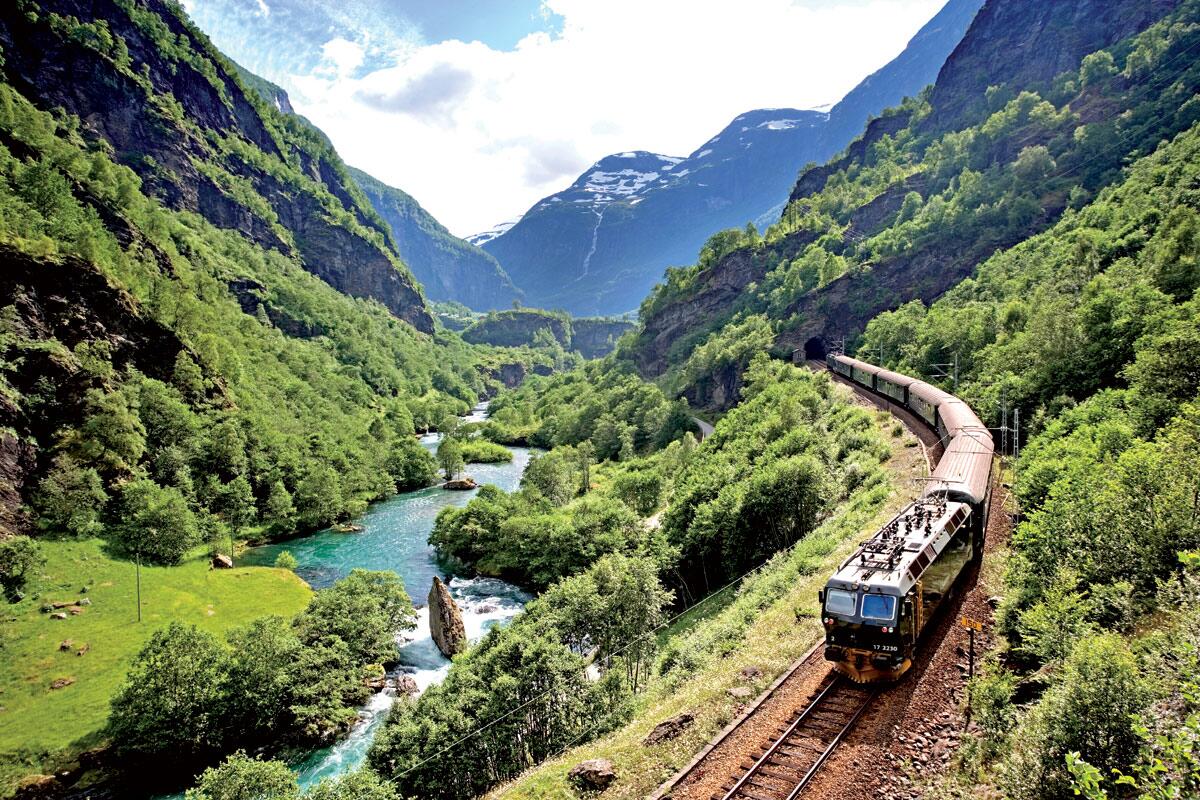
After waiting for 18 months I'm
nearly there: http://www.visitflam.com/flam-railway/ Just have to "endure" the Bergen
Line for another 30 minutes :) (eta 1715)
Crossrail’s seventh tunnel boring machine, Jessica, will start a new race from Stratford today.
Named after Olympic champion Jessica Ennis-Hill CBE, Jessica, the 1,000 tonne tunnel boring machine will start building a new 1.7 mile (2.7 km) Crossrail tunnel from Pudding Mill Lane, near the Olympic Park, to Stepney Green.
She will be followed by sister machine Ellie, named after Paralympic gold medallist Ellie Simmonds OBE, to build a second tunnel.
Students from Marion Richardson Primary School inStepney suggested the names ‘Jessica’ and ‘Ellie’ for the final two of eight Crossrail tunnelling machines undertaking a marathon effort to build 26 miles (42 km) of new rail tunnels under London.
Jessica joins six other Crossrail tunnelling machines working under London which are fast approaching the half way mark in the tunnelling marathon with 11 miles (18 km) of tunnels completed. The new tunnels will connect east and west London and 37 stations from Maidenhead and Heathrow in the west, to Shenfield and Abbey Wood in the east.
Transport Minister Stephen Hammond said: "The Government is investing record amounts in the country’s infrastructure because we recognise its importance in driving the economy forward and pushing the UK ahead in the global race. The launch of the last pair of tunnel boring machines in the shadow of the Olympic Stadium marks another significant milestone in the Crossrail project, as we approach the halfway stage in our tunnelling marathon."
Crossrail Programme Director Andy Mitchell said: "Crossrail is making good progress with more than 11 miles of tunnel now built. We're delighted that our final two tunnelling machines, which start their race at Strateford, have been named after two Olympic heroines and will deliver their own tunnelling marathon under London. The Olympics legacy has transformed Stratford and east London, and Crossrail too will transform the way Londoners travel, and support regneration across the capital."
School students in the Stratford area were asked to suggest names for the new tunnelling machines. Crossrail workers including those working on Jessica and Ellie then voted on a shortlist of names put forward by the students.
The naming of TBMs after women is a long-held tunnelling tradition and the names of Crossrail’s first six TBMs were each inspired by British heritage and history.
Tunnelling machines Ada and Phyllis were named after early computer scientist Ada Lovelace and Phyllis Pearsall who created the London A-Z. They are constructing the tunnel between Royal Oak and Farringdon.
Elizabeth and Victoria, in east London, were named after Queen Victoria and Queen Elizabeth II and are building the Canning Town to Farringdon tunnel.
Mary and Sophia, in southeast London, were named after the wives of famous railway engineers Isambard Kingdom Brunel and Marc Isambard Brunel. They are constructing the tunnel under the Thames between Plumstead and North Woolwich.
Once Jessica has completed her tunnel drive from Pudding Mill Lane to Stepney, she will then be partially dismantled and taken to the Limmo shaft at Canning Town to construct the final two Crossrail tunnels between Limmo and Victoria Dock Portal. This is the shortest of the Crossrail tunnels with each measuring 900 metres.
More than 8,000 people are currently working directly on Crossrail, which is Europe’s largest construction project, with another 5,000 full time equivalent jobs in its supply chain.
When Crossrail opens in 2018, it will increase London's rail-based transport network capacity by 10 per cent, support regeneration across the capital and the south east, help to secure London's position as a world leading financial centre, and dramatically cut journey times across the city.
ARMONK, N.Y. - 13 Aug 2013: In a recent report examining technology adoption trends by cities, Forrester Research, Inc., cited IBM (NYSE: IBM) for its full set of smart city solution components, making IBM one of only two vendors that is truly a smart city service provider.
In a recent report examining technology adoption trends by cities, Forrester Research, Inc., stated that “The breadth and depth of capability in software and services for city planning and management, human and infrastructure services, along with the ability to analyze and integrate the information and provide executive dashboards and citizen interaction is probably unmatched in the market.”The report, “Service Providers Accelerate Smart City Projects”, Forrester Research, Inc., July 30, 2013, provides recommendations for cities and local governments on how to best use smart city services and work with technology providers.
IBM has an extensive Smarter Cities business, helping cities of all sizes bring together consulting, software, hardware, hosting and maintenance for city planning and management, and human and infrastructure services. The report stated that IBM “brings strong domain expertise and business transformation capabilities.” It also noted that “the company positions itself as a data integrator connecting and integrating disparate city infrastructure systems and making sense of the data they produce to empower the different city stakeholders.”
“I believe this validates IBM’s comprehensive approach to the Smarter Cities market,” said Michael J Dixon, general manager, IBM Smarter Cities. “With a deep understanding of public safety, health, water, transport, education and social services, IBM also provides proven technology and industry expertise to address the business needs of cities.”
The report cites IBM’s work with clients such as the City of Philadelphia which is using advanced analytics and data from the Philadelphia Youth Network and the Workforce Investment Board to identify dropout risks and offer targeted training opportunities. Twenty-six companies were considered in the report which provides an in-depth view of six major vendors including IBM. The capabilities of these companies were assessed by smarter cities expertise, consulting capabilities and partner ecosystem.
The Forrester report also provides advice for cities and emphasizes that cities should recognize the value of technology as a means of transformation. To learn more about the report, “Service Providers Accelerate Smart City Projects” visit: http://www.forrester.com
IBM is helping cities around the world use the vast amount of information already available to deliver more efficient citizen services. IBM’s experience with cities continuously fuels more effective solutions and best practices to help city leaders transform their communities.
Israel’s National Infrastructure Committee Approves Electrification Plans
Israel’s rail network is to be electrified following a decision by the National Infrastructure Committee on Monday, 12th August.
The aim is to improve passenger comfort and significantly reduce pollution, as well as increasing train service reliability and accuracy, according to the Israeli Transportation Minister, Israel Katz, who initiated the “Nativei Yisrael” Project.
Nativei Yisrael will see the country connected by rail from Negev to Galilee and Kiryat Shmona to Eilat. The aim is to reduce social disparities by enabling people to travel to and from the periphery.
Tenders for the electrification of 420km of planned and existing lines, the construction of supporting transformer stations and an electrical control system are expected to be released early in 2014. Seven proposals were submitted during the pre-qualification period.
CEO of Israel Railways, Boaz Tzafir said on Monday that he was pleased with the decision taken by the Infrastructure Committee, saying that the company was keen to work with the public transportation sector in Israel to increase the number and distance of train journeys, and provide safe and efficient transport from point to point. He added that the number of passengers who choose to travel by train would increase, leading to fewer vehicles and accidents on the roads.
Future of railway industry to be discussed throughout major international conference
The future of the railway industry will be discussed throughout a major international conference in Budapest
Important Hungarian role in the unified European railway
Developments taking place at the national railway companies may increase the rail passenger and freight market share in the European transportation. Due to its location, Hungary has an important role in it and also its government has declared it a priority. The growth potential of Hungary will be discussed together with many other important European railway themes throughout a major railway conference, InnoRail 2013 Budapest, between October 28-30 taking place in Hungary.Budapest, 2013. July 31. The market share of European rail transport is stagnating at a stable level since the economic crisis. According to the Single European Rail Area Unit of the European Commission, growth is achievable through a unified European railway where the national railway companies carry out developments and modernizations. Patrizio Grillo, Deputy Head of this Unit, believes that a high-quality and efficient service could be realized by adequate financing and building up the required infrastructure.
Rail transport has traditionally been a strong presence in Europe. Its volume in the European Union has been steadily increasing up until the crisis. While in 1995, the rail freight transportation recorded 386 billion tonne-kilometers and the rail passenger transport recorded 350 billion passenger kilometers, by 2008 these values were 440 and 411 billion respectively, meaning a 14 and a 17 percent increase. As expected during the crisis, both the rail passenger and freight transport volume has decreased, but after 2009 these volumes began to rise again. This increase, however, did not result in increased market share of the rail transport so, therefore, rail passenger transport stagnated at around 6 percent, while the rail freight transport decreased with more than 2 percent to 10 percent.
According to Patrizio Grillo, the fact that there is still a number of different technologies used by the European railway companies – including different track gauge sizes, signaling, electrical equipment and technical standards -, strengthens the need for a unified approach and steers the discussions towards a single European railway area. „This is an ongoing long term project but the European member states, therefore Hungary plays an important role in it because it is a significant transit country and therefore it has a key position in the European rail freight transport”- said the expert.
“Seeing the growth potential of our national railway transport, we have decided that we would like to help our country`s role in the regional and European railway by organizing an international high-quality railway conference” – said Ágnes Balla, the host and organizer of InnoRail 2013 Budapest conference which will be organized between October 28-30. The purpose of the event is to discuss the present and future of the European railway industry jointly with well-known foreign and Hungarian experts – Ágnes Balla explaining the underlying motives.
The main themes of InnoRail 2013 Budapest:
- Trends in transport policy; strategy, regulatory environment and economic challenges of railway infrastructure development
- Development of Railway Infrastructure, new Technologies
- Interoperability, automation and signaling systems, modern control and dispatch
- Power supply
- Risks and safety
***


No comments:
Post a Comment
Tell us your Railway News!