


Railways can be dangerous places.. two men found on the tracks in Birmingham.....a near miss on Translink's Derry railway line..... and passengers drugged and robbed on the Mangala Express, on India's Konkan Railway.
On a more sombre note, Michael Portillo embarks on the final leg of "Railways of the Great War" with poignant recollections of post war events...
Christian Wolmar's excellent history "Engines of War" traces the use of railways in winning and losing wars... It bears out the unfortunate maxim that for every good use there is a bad one.....
Click on the links.....
Headlines
UK
Contactless payment is expanding (TfL on YouTube)
From 16 September your contactless payment card get you around London on the Tube, tram, Overground, DLR and most National Rail services. It's already available on London's buses.
Watch to find out more, and visit http://www.tfl.gov.uk/contactless
-------------------------------------------------------------------------------------------------------------
Two men found seriously injured on rail tracks in Birmingham 'fell from height'.(The Guardian)
City wins deal in battle for High Speed 2 concessions.(Birmingham Post)
Translink issue warning after a near miss on Derry railway line.(BBC News)
Merthyr Tydfil steam train heritage plans unveiled.(BBC News)
Rail company given new 10-year contract.(The Yorkshire Post)
Cleaner and greener transport for communities - News stories - GOV.UK.
Network Rail.
Rail investment in Blackpool continues
Network Rail is to make additional investment in the line between Preston and Blackpool North as part of its commitment to provide a better railway in the north west of England.
As well as electrifying the line, a new modern signalling system will be installed while the track layout at Blackpool North station will be changed to allow for longer trains to serve the town.
The improvements are part of Network Rail’s £1bn+ investment in the north west which will help to provide passengers with a faster, more reliable and efficient railway.
Completing the electrification, signalling and track upgrades at the same time will mean just one period of closure resulting in less future disruption to passengers and less of an impact on the local economy.
Martin Jurkowski, principal sponsor at Network Rail, said: “We have grasped the opportunity of electrification and the need for new signalling to carry out further modernisation and improvement work along the route which will provide a more reliable and efficient railway for Blackpool. This will help to deliver maximum benefits for passengers and while there will be short-term disruption while the work is completed, this will be far outweighed by the long-term benefits. We will work closely with the train operators to minimise disruption as much as possible and to provide passengers with the information they need to plan their journeys during this time.”
Rail minister Claire Perry said: “This is proof that our plan to transform rail travel across the north is progressing and will provide a world-class railway that offers more seats, improved connections and better journeys. This will help secure lasting economic growth across the region.
“In addition to the £1bn being invested in major transport improvements in this area, we have also asked Virgin Trains to look at introducing direct services from Blackpool to London from December, benefiting passengers even further.”
Rob Warnes, programmes and planning director for Northern Rail, said: “We are fully supportive of the further investment by Network Rail to develop the railway in the north. This new approach will allow more improvements to be carried out on the line than had been previously planned. We have been working closely with Network Rail to ensure this is carried out at a time which will have minimal impact on our customers and the local economy of Blackpool.”
Chris Nutton, FTPE programme director, said: "The railway in the north is being invested in and developed to improve customer experience, choice and journey reliability. Some improvements are being made now to allow for extra capacity in the future. We are fully supportive of this joined up approach. The engineering improvements in and out of Blackpool are two fold, with some of the work bringing benefits immediately and some of the work future proofing the infrastructure.
"Whilst any closure of the line is an inconvenience for customers it is much better to only inconvenience passengers once and complete the upgrades in one stretch as opposed to multiple closures."
As a result of this additional investment, the Blackpool line work programme has been rescheduled, with the main works starting in mid-December 2016 and lasting approximately three months, avoiding the key holiday period for the resort. For further information contact Network Rail’s national helpline on 08457 114 141 08457 114 141.
The improvements are part of Network Rail’s £1bn+ investment in the north west which will help to provide passengers with a faster, more reliable and efficient railway.
Completing the electrification, signalling and track upgrades at the same time will mean just one period of closure resulting in less future disruption to passengers and less of an impact on the local economy.
Martin Jurkowski, principal sponsor at Network Rail, said: “We have grasped the opportunity of electrification and the need for new signalling to carry out further modernisation and improvement work along the route which will provide a more reliable and efficient railway for Blackpool. This will help to deliver maximum benefits for passengers and while there will be short-term disruption while the work is completed, this will be far outweighed by the long-term benefits. We will work closely with the train operators to minimise disruption as much as possible and to provide passengers with the information they need to plan their journeys during this time.”
Rail minister Claire Perry said: “This is proof that our plan to transform rail travel across the north is progressing and will provide a world-class railway that offers more seats, improved connections and better journeys. This will help secure lasting economic growth across the region.
“In addition to the £1bn being invested in major transport improvements in this area, we have also asked Virgin Trains to look at introducing direct services from Blackpool to London from December, benefiting passengers even further.”
Rob Warnes, programmes and planning director for Northern Rail, said: “We are fully supportive of the further investment by Network Rail to develop the railway in the north. This new approach will allow more improvements to be carried out on the line than had been previously planned. We have been working closely with Network Rail to ensure this is carried out at a time which will have minimal impact on our customers and the local economy of Blackpool.”
Chris Nutton, FTPE programme director, said: "The railway in the north is being invested in and developed to improve customer experience, choice and journey reliability. Some improvements are being made now to allow for extra capacity in the future. We are fully supportive of this joined up approach. The engineering improvements in and out of Blackpool are two fold, with some of the work bringing benefits immediately and some of the work future proofing the infrastructure.
"Whilst any closure of the line is an inconvenience for customers it is much better to only inconvenience passengers once and complete the upgrades in one stretch as opposed to multiple closures."
As a result of this additional investment, the Blackpool line work programme has been rescheduled, with the main works starting in mid-December 2016 and lasting approximately three months, avoiding the key holiday period for the resort. For further information contact Network Rail’s national helpline on 08457 114 141

Electrification Work. Courtesy Network Rail.
---------------------------------------------------------------------
Railways of the Great War with Michael Portillo.(BBC)
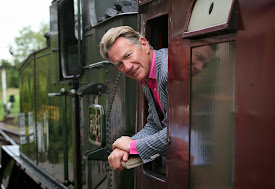
(C) Boundless Productions
Railways and Remembrance
Episode 5 of 5 (Friday 8th August 2014 .BBC2. 1830)
Duration: 30 minutes
World War I was a railway war. Michael Portillo finds out how the railways
helped to precipitate a mechanised war, shaped how it was fought, conveyed
millions to the trenches and bore witness to its end. He takes to historic
tracks to rediscover the locomotives and wagons of the war that was supposed to
end all war and hears the stories of the gallant men and women who used them in
life and in death.
Michael travels through Britain and northern France uncovering railway stories from the Great War. In this final episode, Michael explores the aftermath of this earth-shattering conflict. For four years, the railways had fed the front line with vast numbers of men, munitions and supplies. But even after the Armistice had been signed in a railway carriage, the work of the railways was not done. As Britain continued to mourn its dead, the railways played an important part in their remembrance. Michael hears stories of railway war heroes and encounters a remarkable railway wagon used to honour them. He hears how the railways helped give birth to battlefield tourism and in the cemeteries of Ypres he meets the great grandchildren of some of the fallen.
-------------------------------------------------------------------------------
For a definitive history of the development and role of railways during wars
....
"The nature of warfare changed radically in the 19th century. Contrast the Napoleonic Wars, with battles such as Waterloo that were decided in a day, with the prolonged and entrenched conflict that characterised the First World War a century later.
What brought about this remarkable change? The Napoleonic Wars were the last major battles fought before the crucial invention that transformed the very nature of how wars were conducted: the railways. Yet, this aspect of military history has been widely ignored. There has been much focus on how the development of weaponry increased the efficiency of armies as killing machines but little attention has been paid to how the weapons got to the front. And it was the railways which changed the logistics of war.
Napoleon was actually an innovator; he just had the bad luck to be around before the invention of the railways. Unlike many of his successors who led armies in Europe and elsewhere during the railway age, Napoleon would have known how to use them. Napoleon even called the long series of wagons which were used to supply his armies ‘trains’ but despite his awareness of the vital nature of transport in fighting wars, he was restricted by the technology of the day and crucially the appetite of horses which were used not only for cavalry but also transport. Carts pulled by horses could manage barely 25 miles per day and oxen were even slower. If the supplies were too far behind the lines, animal power was useless since the horses would need to eat more than they could transport.
The railways changed that equation. Herman Haupt, the railway genius of the American Civil War, reckoned that a single track line could supply an army of 200,000 men, provided it was operated in a correct way. That meant the railways had to be run by experienced managers who could not be bullied by army officers and had the ultimate say over the timetable. It took a number of wars for that to be understood. Although railways played a role in a number of earlier conflicts such as the Crimean where a specially created railway helped the British and French forces eventually take Sebastopol, the American Civil War was undoubtedly the first ‘railway war’. And that is why it was both long and deadly. Not only did it last four years – between 1861 and 1865 – but the breadth of the conflict which raged over an area the size of Europe its bloodiness. More American soldiers – over 600,000 – died in the war than in all other conflicts in which the US has been involved subsequently.
Moreover, during those four long years of carnage, there were no fewer 400 encounters – one every four days – which were serious enough to be recorded as ‘battles’ and it was the mobility afforded by the railways which made such a high level of activity possible. From the first battle to almost the last, the railways were involved. The arrival of troops by rail proved decisive in the earliest big battle, the Battle of Bull Run in Virginia, twenty miles from Washington. The Northerners had the rebel forces on the run until reinforcements arrived by train on the Manassas Gap Rail Road which allowed them to counter attack and give the Southerners victory. Throughout the war massive troop movements across huge distances were made on the railways with the biggest being the 1,200 mile journey by 20.000 men from east to west along the boundary between the rival armies in early autumn 1863. The troops were sent from the Eastern seaboard to reinforce the beleaguered Northern troops at Chattanooga, Tennessee, a vital rail hub, and were vital in stopping the South from taking over the state after an earlier northern defeat.
It was not only troops that were moved by rail, but all the supplies and ammunition essential to maintain the armies. Indeed, in what became known as the Western Theater, west of the Mississippi, battles would not have been possible without the railways since the area was largely uncultivated and troops would not have been able to live off the land. From then until the Korean War, virtually every war involved the heavy use of railways. Battles were fought over railway junctions, the launch of attacks was determined by how quickly men could be mobilised by train and ammunition became ever heavier thanks to the ability of the railways to deliver ever greater quantities.
Railways reached their height of indispensability in the First World War when road transport was still in its infancy. The First World War was, in essence, a railway war and the terrible stalemate of three and a half years on the Western Front was the result of the railways’ ability to deliver vast quantities of supplies to a static front, something that would have been unthinkable in Napoleon’s day.
If there is any doubt that the use of railways war is a neglected subject, I leave the last word to Lloyd George. He noted that the histories of the First World War tended to ignore this aspect of warfare and in 1932, commented on the coverage in John Buchan’s History of the War: ‘The Battle of the Somme has about 60 pages, and yet it did not make that much difference in the war; but the shells and the guns that enabled the army to fight it, all the organisation of transport behind the lines, do you know how much is given to this? 17 lines’.
My book attempts to begin to redress the balance."
Get your copy of this must read book ....Here
... see a 15 minute slide show of this book, featuring the First World War.....
Michael travels through Britain and northern France uncovering railway stories from the Great War. In this final episode, Michael explores the aftermath of this earth-shattering conflict. For four years, the railways had fed the front line with vast numbers of men, munitions and supplies. But even after the Armistice had been signed in a railway carriage, the work of the railways was not done. As Britain continued to mourn its dead, the railways played an important part in their remembrance. Michael hears stories of railway war heroes and encounters a remarkable railway wagon used to honour them. He hears how the railways helped give birth to battlefield tourism and in the cemeteries of Ypres he meets the great grandchildren of some of the fallen.
-------------------------------------------------------------------------------
For a definitive history of the development and role of railways during wars
....
"The nature of warfare changed radically in the 19th century. Contrast the Napoleonic Wars, with battles such as Waterloo that were decided in a day, with the prolonged and entrenched conflict that characterised the First World War a century later.
What brought about this remarkable change? The Napoleonic Wars were the last major battles fought before the crucial invention that transformed the very nature of how wars were conducted: the railways. Yet, this aspect of military history has been widely ignored. There has been much focus on how the development of weaponry increased the efficiency of armies as killing machines but little attention has been paid to how the weapons got to the front. And it was the railways which changed the logistics of war.
Napoleon was actually an innovator; he just had the bad luck to be around before the invention of the railways. Unlike many of his successors who led armies in Europe and elsewhere during the railway age, Napoleon would have known how to use them. Napoleon even called the long series of wagons which were used to supply his armies ‘trains’ but despite his awareness of the vital nature of transport in fighting wars, he was restricted by the technology of the day and crucially the appetite of horses which were used not only for cavalry but also transport. Carts pulled by horses could manage barely 25 miles per day and oxen were even slower. If the supplies were too far behind the lines, animal power was useless since the horses would need to eat more than they could transport.
The railways changed that equation. Herman Haupt, the railway genius of the American Civil War, reckoned that a single track line could supply an army of 200,000 men, provided it was operated in a correct way. That meant the railways had to be run by experienced managers who could not be bullied by army officers and had the ultimate say over the timetable. It took a number of wars for that to be understood. Although railways played a role in a number of earlier conflicts such as the Crimean where a specially created railway helped the British and French forces eventually take Sebastopol, the American Civil War was undoubtedly the first ‘railway war’. And that is why it was both long and deadly. Not only did it last four years – between 1861 and 1865 – but the breadth of the conflict which raged over an area the size of Europe its bloodiness. More American soldiers – over 600,000 – died in the war than in all other conflicts in which the US has been involved subsequently.
Moreover, during those four long years of carnage, there were no fewer 400 encounters – one every four days – which were serious enough to be recorded as ‘battles’ and it was the mobility afforded by the railways which made such a high level of activity possible. From the first battle to almost the last, the railways were involved. The arrival of troops by rail proved decisive in the earliest big battle, the Battle of Bull Run in Virginia, twenty miles from Washington. The Northerners had the rebel forces on the run until reinforcements arrived by train on the Manassas Gap Rail Road which allowed them to counter attack and give the Southerners victory. Throughout the war massive troop movements across huge distances were made on the railways with the biggest being the 1,200 mile journey by 20.000 men from east to west along the boundary between the rival armies in early autumn 1863. The troops were sent from the Eastern seaboard to reinforce the beleaguered Northern troops at Chattanooga, Tennessee, a vital rail hub, and were vital in stopping the South from taking over the state after an earlier northern defeat.
It was not only troops that were moved by rail, but all the supplies and ammunition essential to maintain the armies. Indeed, in what became known as the Western Theater, west of the Mississippi, battles would not have been possible without the railways since the area was largely uncultivated and troops would not have been able to live off the land. From then until the Korean War, virtually every war involved the heavy use of railways. Battles were fought over railway junctions, the launch of attacks was determined by how quickly men could be mobilised by train and ammunition became ever heavier thanks to the ability of the railways to deliver ever greater quantities.
Railways reached their height of indispensability in the First World War when road transport was still in its infancy. The First World War was, in essence, a railway war and the terrible stalemate of three and a half years on the Western Front was the result of the railways’ ability to deliver vast quantities of supplies to a static front, something that would have been unthinkable in Napoleon’s day.
If there is any doubt that the use of railways war is a neglected subject, I leave the last word to Lloyd George. He noted that the histories of the First World War tended to ignore this aspect of warfare and in 1932, commented on the coverage in John Buchan’s History of the War: ‘The Battle of the Somme has about 60 pages, and yet it did not make that much difference in the war; but the shells and the guns that enabled the army to fight it, all the organisation of transport behind the lines, do you know how much is given to this? 17 lines’.
My book attempts to begin to redress the balance."
Get your copy of this must read book ....Here
... see a 15 minute slide show of this book, featuring the First World War.....
www.transport-network.co.uk
Comment: Christian Wolmar on rail nationalisation
Compromises are not always a good idea in politics. This is especially true when dealing with highly complex issues like rail franchising.
On the face of it, the idea of allowing a state owned company, such as Directly Operated Railways, to bid for franchises coming to the end of their term seemed the obvious way to get Labour off the hook. The party was torn between two conflicting views.On the left, there was a demand for complete renationalisation which meant simply taking in-house franchises which ran out. This was presented as a cheap expedient, a simple way of bringing to the end the expensive and inflexible franchising system with no need to pay any compensation. Moreover, it was presented as popular since poll after poll has shown that a majority of respondents would like a return to public ownership, even if they are somewhat unclear as to how that would work.
On the right, however, there was terror that this would be seen as ‘anti-business’. Therefore a rearguard action was fought. Realising that simply saying the status quo would remain was unacceptable to the majority of party activists, a compromise was thrashed out and leaked widely to the press. This was to allow DOR or a similar body to bid for franchises against private sector operators.
While this may seem like a good compromise, in fact in practice there are all sorts of pitfalls. Bidding, for a start, is expensive, involving perhaps £5m or more for complex deals. Unlike DB or SNCF who regularly bid for franchises and regional operations in their home countries, there is no ready made state railway to prepare bids.
Therefore teams will have to be hastily and expensively brought together.
Secondly, the state supported bids are quite likely to fail given that there are normally three or four bidders, and the private operators may well have more flexibility in what they put into the bids. A state-owned company will be hamstrung by government rules and bureaucracy.
And thirdly, if, as most within the Labour agree, the franchising system is not the best way to run a railway, this process will effectively guarantee that it remains unchanged. All in all, the compromise is the worst, and not the best, of all worlds.
Actually, the precise nature of the implications of the policy that will be included in the manifesto remain unclear. At the meeting of the National Policy Forum in Milton Keynes in July, a form of words was agreed that said there would no longer be ‘a presumption against the public sector’ and that the whole franchising system would be reviewed. What this means in practice will only become clear after the general election when, probably, the same battles will still be fought but on a more public stage.
-----------------------------------------------------------------------------
Update from the Chairman on the future of the West Somerset Railway.(WSR)
(08/08/2014 @ 08:21:00)
I would like to share some of the recent communications we have received from Somerset County Council on a number of matters related to the freehold, leasehold and improving stakeholder involvement across the West Somerset Railway. SCC felt these were needed after some mixed messages that have been circulating over these matters, and having acknowledged that they could help clarify a complex situation, which may have been misunderstood or misrepresented to some extent. They have communicated similarly with the WSRA.
1 SCC has confirmed that the minutes of their recent public scrutiny meeting will now record John Osman's commitment as leader that ' the freehold will never be sold outside of the West Somerset Railway Family' in answer to the direct question from myself on this issue.
Officer's letters have reiterated that
2 The freehold is NOT for sale.
3 Under the existing lease the PLC will continue capably as the 'duty holder' and duly designated 'fit and proper persons' to operate the WSR.
They have confirmed that
4 Having taken advice and considered ORR and HRA best practice over the requirements to avoid any conflict with the governance and responsibilities of the duty holder, SCC will not set up a stakeholder group, but will welcome and join one set up by the West Somerset Railway. As a result I have therefore written to representatives of the various support groups on the railway, including WSRA, other charities and stations friends groups, together with local authorities and with appropriate staff involvement, for them to join the WSR Partnership Development Group as set out in our 10 year corporate plan. In their letter, SCC encouraged us to do this, and have already confirmed their agreement to participate in this new body.
5 The lease of the WSR is a commercial matter between the PLC and SCC, but will not be progressed currently. In order to give time for reflection by the WSR family, SCC has stated that it will not enter into further dialogue with the PLC as leaseholder over an extended lease with a pre-emption right on the freehold were it ever to become available until a period of at least 6 months has elapsed. This would confirm the commitment given in point 1, whilst allowing consultation within the WSR family over any future potential implementation of such a right.
Both the PLC and SCC hope this will help allay concerns that there is not, and has never been, a real risk to the freehold of being sold by SCC outside of the WSR, as had been suggested in some quarters.
I will give more details of this initiative as we progress, aiming to involve a much wider consultation with key stakeholders over the future strategy and direction for the WSR, whilst refocussing on our key priority of how to ensure its operation and future sustainability.
John Irven Chairman WSR PLC, 7 August 2014-------------------------------------------------

India
Foreign equity can flag next leg of Indian rail's journey.(Business Today)
Vigilant Konkan Railway TTE saves drugged passengers on Mangala Express.(Times of India)
Double decker train on Konkan Railway to be introduced.(Times of India)

Courtesy: Konkan Railway.
USA
www.progressiverailroading.com.
Other Railway Press Releases
UIC launches global railway MBA - Railway Gazette
Bombardier highlights capacity, efficiency and urban flow at InnoTrans 2014 - Railway Gazette
www.railway-technology.com.
UK Government plans Crossrail extension to Hertfordshire
The UK Government has launched a study into potential Crossrail extension that would provide faster rail services for passengers in Hertfordshire.
Transnet secures $557.7m funding guarantee to buy US locomotives
South African rail operator Transnet has secured a $557.7m funding guarantee with US export credit agency US-Exim for the purchase of more than 1,000 locomotives.
Network Rail to upgrade Blackpool rail line in north-west England
Network Rail has announced plans for additional investment to improve the rail line between Preston and Blackpool North, in order to provide better services in north-west England.
SRO signs first phase of doubling Dammam to Riyadh freight mainline contract
Saudi Railways Organization (SRO) has signed a contract with a local firm to begin work on doubling the country's freight mainline, in a bid to increase capacity and meet private sector transportation demand.
Siemens.
ÖBB order further nine Railjet units
Berlin, 2014-Aug-01
- Order worth approx. 145 million euros
- ÖBB fleet grows to 60 Railjets in total
- Deployment planned for the western route and the route to Venice

Siemens Press Picture
"Our Railjet is the hallmark of more than 160 years of Siemens' experience in the passenger coach industry. Our Vienna plant is home to the Siemens' World Competence Center for the development and manufacture of passenger vehicles, so we are especially delighted that ÖBB have once again placed their trust in us and expanded their Railjet fleet to no less than 420 cars", said Jochen Eickholt, CEO of Siemens Rail Systems.
The technical design is based on the service-proven Viaggio Comfort type intercity vehicles, and the trains meet all the requirements for international high-speed rail operation. The standard configuration for the new trains consists of four different types of vehicle: a driving trailer with business and first class seating; a bistro car; and five open-saloon type cars for economy class, one of which has a zone for families with children as well as a multi-purpose area. There is an area available to disabled passengers in the bistro car, which wheelchair users can access, via a platform lift fitted to the carriage entrance, with the aid of the train's crew. All cars are fully air-conditioned.
The new trains are equipped with the Ecojet package, composed of LED lighting and an energy-optimized air-conditioning system that uses CO2 sensors to detect the number of passengers in the carriage and adjusts its output accordingly. A Siemens research project concluded that this package could save ÖBB more than five million euros of its annual energy costs for operating the current Railjet fleet.
Railjets are propelled in push-pull mode by a Taurus locomotive, and each unit is 186 meters long, or 205 meters with the locomotive included. The trains are designed to travel at speeds of up to 230 km/h.
Russian Railways on YouTube
"Your heart will open to Russian Railways"
Moscow-Volgograd train Master, Elena Myasina, speaking of her job and the most important role in passengers’ comfort support.


No comments:
Post a Comment
Tell us your Railway News!